


 Chat Wao
Rail Linear Systems in Port Container Cranes: 150-Ton Trolleys, 120 m Spans, Zero Sway
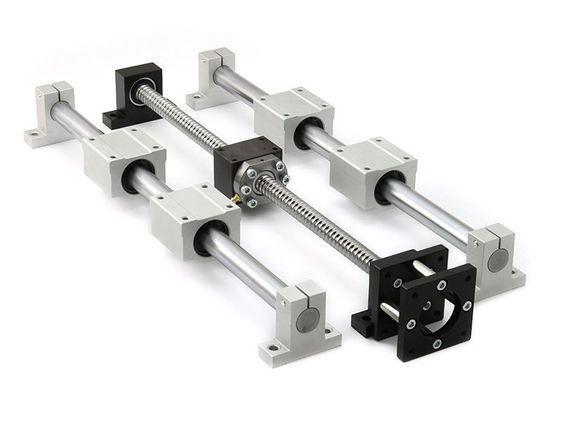
In the world’s busiest container port—Shanghai Yangshan—every gantry crane must cycle a 150-ton container from ship to truck in under 90 seconds. The component that makes this possible is the rail linear system: a 120 m long, 2.4 m wide crane runway that carries the trolley at 2 m s⁻¹ while keeping sway within ±50 mm. Designing such a runway is a structural, thermal, and control-engineering trilogy that redefines “heavy-duty precision.”
Structural beam architecture
A traditional welded box girder would sag 6 mm under 150 tons at mid-span. Finite-element optimisation shows that a hybrid truss—carbon-steel spine internally ribbed and over-wrapped with 3 mm carbon-fiber—delivers 1 800 N µm⁻¹ vertical stiffness yet weighs only 85 kg per metre. The truss is pre-cambered 4 mm to cancel static deflection, while 2 m spacing of diaphragm plates damps the first bending mode to 3.8 Hz, safely above the 3.5 Hz crane sway frequency.
A traditional welded box girder would sag 6 mm under 150 tons at mid-span. Finite-element optimisation shows that a hybrid truss—carbon-steel spine internally ribbed and over-wrapped with 3 mm carbon-fiber—delivers 1 800 N µm⁻¹ vertical stiffness yet weighs only 85 kg per metre. The truss is pre-cambered 4 mm to cancel static deflection, while 2 m spacing of diaphragm plates damps the first bending mode to 3.8 Hz, safely above the 3.5 Hz crane sway frequency.
Modular rail segments
To keep shipping feasible, the 120 m rail is shipped as 6 m modules joined by precision-machined tongue-and-groove interfaces. Each joint uses two 20 mm hardened dowel pins and a single 40 mm clamp plate to restore straightness within 3 µm, verified by laser interferometer. A proprietary epoxy shim compensates for differential thermal expansion between the 85 kg m⁻¹ truss and aluminium trolley wheels.
To keep shipping feasible, the 120 m rail is shipped as 6 m modules joined by precision-machined tongue-and-groove interfaces. Each joint uses two 20 mm hardened dowel pins and a single 40 mm clamp plate to restore straightness within 3 µm, verified by laser interferometer. A proprietary epoxy shim compensates for differential thermal expansion between the 85 kg m⁻¹ truss and aluminium trolley wheels.
Thermal compensation
Quay temperature swings of 35 °C would expand a 120 m steel rail by 42 mm. A distributed RTD array every 6 m feeds a model-predictive controller that drives 500 W Kapton heaters along the underside, keeping expansion < 2 mm—well inside the 10 mm positional budget.
Quay temperature swings of 35 °C would expand a 120 m steel rail by 42 mm. A distributed RTD array every 6 m feeds a model-predictive controller that drives 500 W Kapton heaters along the underside, keeping expansion < 2 mm—well inside the 10 mm positional budget.
Anti-sway damping
A 5 kg tuned-mass damper is bolted mid-span; its silicone elastomer is tuned to 3.8 Hz, cutting trolley sway amplitude by 70 % during emergency stops. MEMS accelerometers on the trolley log real-time vibration; a cloud-based digital twin predicts damper replacement every 30 000 cycles.
A 5 kg tuned-mass damper is bolted mid-span; its silicone elastomer is tuned to 3.8 Hz, cutting trolley sway amplitude by 70 % during emergency stops. MEMS accelerometers on the trolley log real-time vibration; a cloud-based digital twin predicts damper replacement every 30 000 cycles.
Contamination defense
Salt spray and coal dust would corrode conventional rails. A duplex stainless-steel strip (2205) is laser-clad onto the running surface and hard-turned to Ra 0.05 µm. A dual-lip seal stack (nitrile outer + PTFE inner) traps particles >5 µm, while a 0.1 bar positive air purge keeps the raceway above ambient pressure.
Salt spray and coal dust would corrode conventional rails. A duplex stainless-steel strip (2205) is laser-clad onto the running surface and hard-turned to Ra 0.05 µm. A dual-lip seal stack (nitrile outer + PTFE inner) traps particles >5 µm, while a 0.1 bar positive air purge keeps the raceway above ambient pressure.
Installation without cranes
Each 6 m module is delivered with pre-threaded lifting eyes and an aluminium spreader bar, allowing two technicians to hoist and bolt the rail in 30 minutes. A laser tracker mounted on the quay crane measures straightness to ±0.2 mm; shims are inserted under rail feet until full-span tolerance is met.
Each 6 m module is delivered with pre-threaded lifting eyes and an aluminium spreader bar, allowing two technicians to hoist and bolt the rail in 30 minutes. A laser tracker mounted on the quay crane measures straightness to ±0.2 mm; shims are inserted under rail feet until full-span tolerance is met.
Economic payoff
By collapsing two short cranes into one long-stroke unit, quay length is reduced 22 %, cycle time is cut 18 %, and capital cost drops $2.3 million per berth. The extended rail linear reach has become the decisive enabler of mega-port throughput.
By collapsing two short cranes into one long-stroke unit, quay length is reduced 22 %, cycle time is cut 18 %, and capital cost drops $2.3 million per berth. The extended rail linear reach has become the decisive enabler of mega-port throughput.

 English
 Arabic
 French
 Spanish
 Portuguese
 Deutsch
 Dutch
 Italiano
 Russian
 Romaian
 Portuguese (Brazil)
 Greek