


 Chat Wao
Market Dynamics and Innovations Steering the Satellite Propulsion Industry Forward
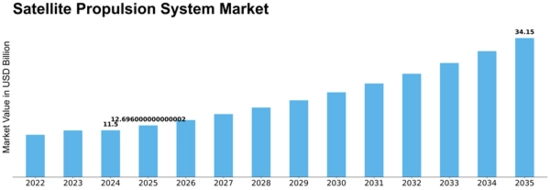
The excitement around satellite launches often overshadows what happens after deployment—yet it is the propulsion system that ensures satellites fulfil their missions. With the Satellite Propulsion System Market forecast to grow from roughly US$11.5 billion in 2024 to about US$34.15 billion by 2035, the focus on mobility, manoeuvre and mission-lifetime is intensifying—implying a compounded annual growth rate near 10.4%.
Industry Overview
Propagation of satellites for telecommunications, earth-observation, navigation and scientific endeavours has broadened the scope of propulsion needs. As spacecraft become more complex and mission-profiles more demanding, propulsion systems must address orbit-raising, station-keeping, collision-avoidance, de-orbiting and even spacecraft relocation. The broader ecosystem now spans thrusters, propellants, controls, system integration and after-launch support.
Key Players & Market Leadership
In this space, firms such as Aerojet Rocketdyne, Northrop Grumman and Airbus Defence and Space are shaping the market’s future. Their initiatives—spanning electric propulsion, strategic acquisitions and sustainability programmes—set benchmarks for the industry. Smaller firms and specialised suppliers often align with or support these leaders, creating a collaborative yet competitive network.
Growth by Segments
When categorising the market, propulsion types such as cold gas, pulsed plasma thrusters, green liquid systems, water-electrolyzed, hydrazine micro-electrospray, iodine Hall, solar sail and ambipolar thrusters appear. Cold gas remains the largest segment due to its proven reliability and cost-effectiveness. On the other hand, green liquid propulsion is emerging as the fastest growing segment, driven by eco-conscious mission design and regulatory expectations. In terms of regional share: North America leads with around 45 %, Europe approximately 30 %, Asia-Pacific about 20 % and the Rest-of-World around 5 %.
Outlook for the Next Decade
Several headwinds are giving way to tailwinds. The rise in small-satellite constellations demands lighter, more efficient propulsion systems. Governments and private players alike are investing heavily in space infrastructure and services. Sustainability concerns push greener propulsion solutions. Also, mission-lifetimes are extending and servicing in orbit is becoming viable, which adds complexity and opportunity for propulsion manufacturers. The market is thus not just growing—it is evolving. The competitive focus will shift to system lifecycle, flexibility of integration and cost-effectiveness across mission classes.
Conclusion
For mission planners, system integrators and propulsion-equipment manufacturers, the message is clear: propulsion systems are no longer peripheral—they are central to mission outcomes. With substantial growth expected over the next decade, innovation in propulsion architecture, propellant chemistry and integration will define winners. The propulsion market is ready for lift‐off.

 English
 Arabic
 French
 Spanish
 Portuguese
 Deutsch
 Turkish
 Italiano
 Russian
 Romaian
 Portuguese (Brazil)
 Greek
Greek