

The Importance of Marine Navigation Lights in the Overall Marine Lighting System

The importance of marine navigation lights within a ship’s overall lighting system goes far beyond “a few lanterns.” They are a legally mandated “visual ID card,” a silent but globally understood language between bridges, and—most critically—a lifeline for any vessel in darkness, fog, or congested traffic. Their value can be summarized under four headings: safety, regulatory compliance, system reliability & economy, and multi-role information exchange.
The first barrier against collision
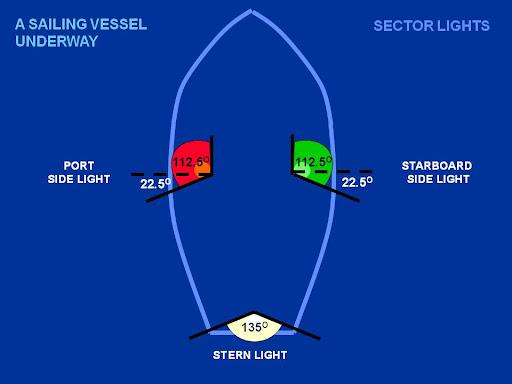
At night or in restricted visibility, more than 70 % of the information reaching the OOW arrives through the eye; navigation lights are the only equipment that simultaneously convey position, heading, ship type and status. The standard red-port / green-starboard / white-masthead & stern combination lets an approaching vessel assess the encounter geometry miles away and take early avoiding action, sharply reducing collision risk.
In busy lanes, fishing zones or fairways, sharply controlled beams project the signal only into the required sectors, eliminating glare and “light spill” that can confuse other mariners—effectively adding a silent, failsafe data link alongside VHF voice.
In ice fields, around rigs or among unlit reefs, navigation lights form a “light line” with lighthouses and buoys, helping the ship keep the safe bearing and reducing grounding risk.
A rigid regulatory requirement
SOLAS and COLREGs set mandatory values for colour, range, arc, redundancy and monitoring. Any non-conformance can lead to PSC detention, fines or even withdrawal of class—translating into lost hire and higher insurance premiums.
Flag-State, Port-State and class surveys all treat navigation lights as a “must-pass” item. Modern LED lanterns incorporate optical-feedback sensors and remote alarms that warn the crew before luminous flux falls below the statutory minimum, ensuring continuous compliance.
With the advent of smart and autonomous ships, navigation lights must interface with radar, AIS and computer-vision systems. Only lanterns that deliver a tightly controlled beam and a digital health status can be trusted by machine-learning algorithms and future regulations.
A critical node for system reliability and cost control
Although the electrical load is tiny, navigation lights share the highest safety integrity level: fed from both main and emergency switchboards, they are grouped with steering gear and fire pumps as “vital consumers.” Automatic change-over to batteries or the emergency generator guarantees the ship remains visually identifiable even after a total blackout.
LED units rated at 50 000–70 000 h last roughly twenty times longer than filament bulbs; with precision optics they deliver the same range while drawing 60 % less power. On an 8 000-TEU container ship the annual saving in generator fuel and electricity exceeds USD 10 000 and cuts CO₂ emissions accordingly.
Addressable lanterns convert “fail & repair” into “condition-based maintenance,” eliminating frequent climbs to the masthead, reducing spares inventory and off-hire time; life-cycle cost drops to about 40 % of the traditional solution.
A hub for extended signalling and data tasks
Naval, research and submarine platforms now use “dim-mode” or IR/UV beacons that are invisible to the naked eye but readable through night-vision equipment, allowing covert identification and tactical coordination.
Signalling lamps can transmit Morse when VHF is jammed or during radio silence—useful for port entry requests or SAR coordination; survivors or aircraft locate a distressed vessel quickly via her high-intensity flashing beacon.
As offshore wind farms, USVs and autonomous freighters proliferate, navigation lights are being integrated with Visible-Light Communication (VLC) and optical imaging sensors, turning each lantern into an edge node of the maritime IoT and feeding real-time status to digital fairways and smart-berth systems.
Conclusion
From the kerosene masthead lamp of sailing-ship days to today’s satellite-synchronised, self-diagnosing solid-state lanterns, “running lights” have remained the most direct, reliable and universally understood interface between ship and ship, and between ship and sea. They are the highest-safety, most stringently regulated and fastest-evolving branch of a vessel’s lighting system, as well as the first luminous shield protecting life, cargo and the marine environment. Investing in high-quality, precision-beam, smart-monitored navigation lights is an investment in safe operation, regulatory readiness and commercial efficiency—an axiom that holds true for every merchantman, warship or offshore unit afloat.