Modern cities are filled with glass curtain walls, skyscrapers, hotels, office towers, and mixed-use developments. Keeping these buildings clean is essential not only for appearance but also for protecting facade materials and maintaining property value.
Today, building owners have more window cleaning methods available than ever before. Traditional systems such as rope access and gondolas remain common, while cleaning drones are becoming an increasingly practical option for many types of facade cleaning projects.
This article compares the five most widely used high rise window cleaning methods to help facility managers, property owners, and cleaning contractors select the most suitable solution.
Common High-Rise Window Cleaning Methods
The five most common approaches include:
Rope Access
Building Maintenance Unit (BMU)
Gondola (Suspended Platform)
Scissor Lift
Cleaning Drone
Each method serves different building heights, facade structures, budgets, and operational requirements.
Rope Access
Rope access uses certified technicians suspended by industrial ropes to clean windows and building facades manually.
Advantages
Excellent flexibility for irregular building designs
A Building Maintenance Unit is a permanent mechanical system installed on rooftops that moves suspended platforms across the building facade.
Advantages
Designed specifically for tall buildings
High operational stability
Suitable for regular maintenance schedules
Can support multiple maintenance tasks beyond window cleaning
Limitations
High installation cost
Requires dedicated rooftop space
Usually planned during building construction
Maintenance of the BMU itself is required
Best Applications
Commercial skyscrapers
Landmark buildings
Premium office towers
Airports and large public buildings
Gondola (Suspended Platform)
Temporary suspended platforms, commonly called gondolas, are widely used for facade cleaning and exterior maintenance.
Unlike permanent BMUs, gondolas can be installed temporarily for cleaning projects.
Advantages
Lower investment than BMUs
Suitable for medium- and high-rise buildings
Can carry multiple workers and equipment
Effective for large flat curtain walls
Limitations
Setup and dismantling require time
Wind restrictions affect operation
Requires rooftop anchoring systems
Less suitable for buildings with complex geometry
Best Applications
Hotels
Apartment buildings
Commercial buildings
Curtain wall maintenance
Scissor Lift
Scissor lifts provide elevated working platforms for exterior cleaning but have relatively limited working heights.
Advantages
Easy to operate
Stable working platform
Fast deployment
Suitable for indoor and outdoor work
Limitations
Limited maximum working height
Requires sufficient ground access
Cannot reach recessed or overhanging facades
Inefficient for skyscrapers
Best Applications
Shopping malls
Low-rise office buildings
Schools
Industrial facilities
Glass entrances
Cleaning Drone
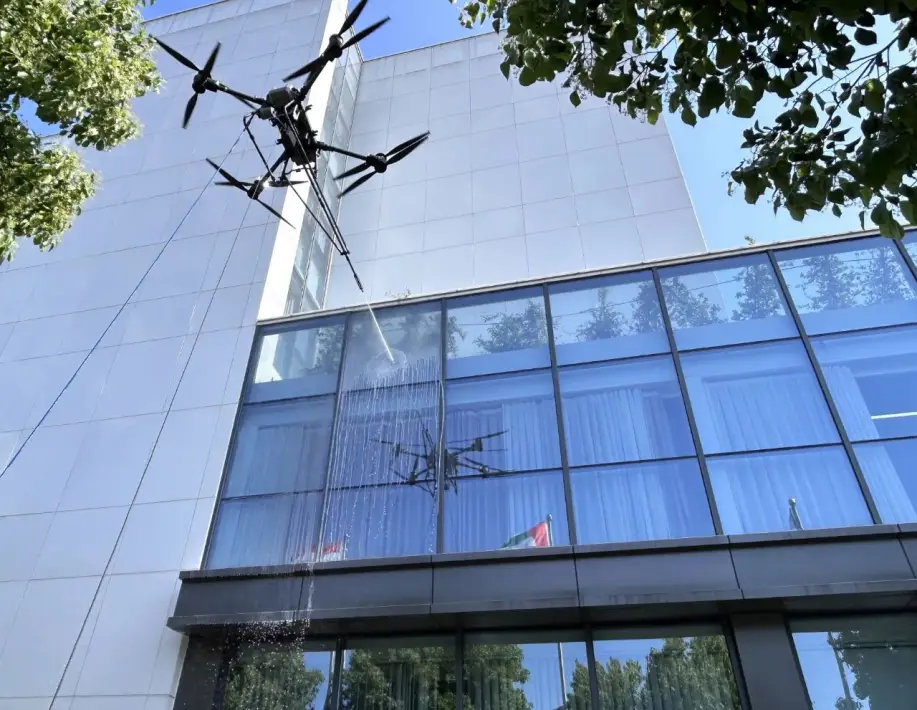
Cleaning drones are one of the newest developments in high rise window cleaning. Instead of suspending workers on ropes or platforms, drones use high-pressure water systems, soft brushes, or specialized cleaning nozzles to remove dust and contaminants from building facades.
Many systems remain connected to the ground through water hoses and power cables, allowing longer operating times than battery-only drones.
Advantages
Improved Worker Safety
Operators remain on the ground while the drone performs cleaning at height, reducing exposure to fall hazards.
Faster Deployment
Most drone systems require significantly less setup compared with suspended platforms or rope systems.
Flexible Access
Cleaning drones can access glass curtain walls, irregular facades, atriums, and difficult architectural features that are challenging for traditional equipment.
Lower Labor Requirements
A small operating team can often complete work that previously required multiple technicians working at height.
Reduced Building Disruption
Drone operations generally require smaller exclusion zones and less equipment around the building entrance.
Limitations
Performance depends on weather conditions
Not all facade materials require the same cleaning system
Very heavy contamination may still require manual treatment
Local aviation regulations must be followed
Best Applications
Glass curtain wall buildings
Hotels
Office towers
Commercial complexes
Airports
Exhibition centers
Modern architectural landmarks
Comparison of High-Rise Window Cleaning Methods
Method
Maximum Height
Safety
Cleaning Efficiency
Initial Investment
Flexibility
Rope Access
Very High
Medium
Medium
Low
Excellent
BMU
Very High
High
High
Very High
Medium
Gondola
High
High
Medium-High
Medium
Medium
Scissor Lift
Low-Medium
High
Medium
Medium
Low
Cleaning Drone
High
Very High
High
Medium
Excellent
Which Window Cleaning Method Is Best?
The best solution depends on several factors:
Building Height
Scissor lifts are practical for low-rise buildings, while BMUs, rope access, gondolas, and drones are better suited to taller structures.
Building Design
Buildings with irregular facades or complex architectural elements often benefit from rope access or drone-based cleaning.
Cleaning Frequency
Buildings requiring frequent maintenance may justify the investment in permanent BMU systems.
Safety Priorities
Reducing work at height has become a growing priority for property managers. Cleaning drones can significantly reduce worker exposure while maintaining cleaning efficiency.
Budget
Traditional rope access generally has the lowest equipment cost, whereas BMUs require the highest capital investment. Cleaning drones occupy a middle ground, offering modern technology without permanent building modifications.
Future Trends in Facade Cleaning
As building designs become more complex and safety regulations continue to evolve, the facade cleaning industry is gradually adopting automation.
Cleaning drones are increasingly being used alongside traditional methods rather than completely replacing them. For routine maintenance of glass curtain walls, they can improve efficiency and reduce operational risks. Meanwhile, rope access, BMUs, and gondolas remain indispensable for inspections, repairs, and specialized maintenance tasks.
The future of high rise window cleaning is likely to combine multiple technologies, allowing building owners to choose the most efficient solution based on each project's specific requirements.
FAQ
What is the safest method for high-rise window cleaning?
BMUs and cleaning drones generally offer the highest levels of operational safety because they minimize worker exposure to fall hazards. Rope access is also safe when performed by certified technicians, but it inherently involves working at height.
Are cleaning drones replacing rope access?
Not entirely. Cleaning drones are increasingly used for routine facade cleaning, while rope access remains necessary for detailed inspections, repairs, sealant work, and locations that require direct manual intervention.
Which window cleaning method is the most cost-effective?
For occasional projects, rope access often has the lowest upfront cost. For buildings requiring frequent facade cleaning, cleaning drones or permanent BMUs may provide better long-term operational efficiency.
Can cleaning drones clean all building facades?
Cleaning drones work particularly well on glass curtain walls, smooth composite panels, and many modern facade materials. Buildings with severe staining, damaged surfaces, or extensive repair needs may still require manual cleaning or specialized maintenance methods.
How often should high-rise buildings undergo facade cleaning?
Cleaning frequency depends on environmental conditions, building usage, and local pollution levels. Many commercial buildings schedule facade cleaning between two and four times per year to maintain appearance and protect exterior materials.



 Chat Wao


 English
 Arabic
 French
 Spanish
 Deutsch
 Turkish
 Dutch
Dutch
 Italiano
 Russian
 Romaian
 Portuguese (Brazil)
 Greek
Greek