


 Chat Wao
From Pumps To Conveyors: Low-Speed Motor Control Solutions
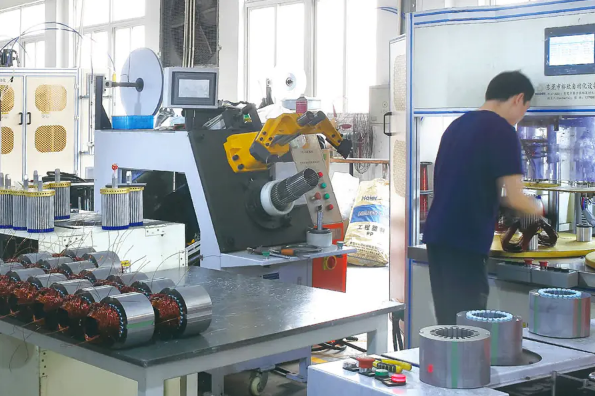
Precision motion control has become a critical requirement across industrial equipment, automation systems, pumps, conveyors, and processing machinery. Engineers often face a challenging question: can a traditional 3 phase asynchronous induction motor achieve ultra-low speed operation with sufficient accuracy, or does it require additional control hardware?
Three-phase induction motors have been widely used because of their rugged construction, simple maintenance requirements, and stable performance under continuous operation. Modern variable frequency drive technologies have expanded their operating range, allowing these motors to move beyond fixed-speed applications. However, ultra-low speed precision introduces new technical challenges related to torque stability, feedback accuracy, and thermal behavior.
Why Ultra-Low Speed Operation Creates Control Challenges
Traditional induction motors are designed around rotating magnetic fields generated by three-phase current. Their speed depends on supply frequency, pole configuration, and slip between the rotating field and rotor speed.
Reduced magnetic field strength appears at very low frequencies and may affect torque output.
Slip variation becomes more noticeable because a small speed difference represents a larger percentage of total rotation.
Cooling efficiency reduction may occur because shaft-mounted fans rotate more slowly at low speeds.
For example, a standard four-pole induction motor running near 50 Hz may operate around 1400–1500 RPM under load. Reducing frequency to only a few hertz can bring rotational speed down significantly, but maintaining rated torque becomes more difficult without appropriate control strategies.
Can Frequency Control Alone Achieve Precision?
A common approach is using a variable frequency drive (VFD) to regulate voltage and frequency together. This method allows the motor speed to follow changing frequency commands. Modern drives can control asynchronous motors through open-loop or closed-loop methods, with some systems supporting advanced torque control functions.
V/F control provides basic speed adjustment for applications with stable loads.
Vector control improves torque response at lower speeds.
Encoder feedback systems enhance positioning accuracy in demanding applications.
Simple frequency adjustment can work for fans, pumps, and general machinery, but ultra-low speed positioning tasks usually require more information about rotor position and load changes. Without feedback, the controller cannot fully compensate for sudden torque disturbances.
The Role Of Motor Design In Low-Speed Performance
The motor itself has a significant influence on low-speed capability. A properly designed 3 phase asynchronous induction motor may include features that improve performance under variable frequency operation.
High-quality magnetic materials help maintain electromagnetic efficiency.
Optimized rotor slot design improves torque characteristics.
Independent cooling systems prevent overheating during slow-speed operation.
Low vibration structures support smoother rotation.
Some frequency-controlled asynchronous motors are designed with wider speed regulation ranges. These motors may operate smoothly from low-frequency conditions up to rated frequency ranges, depending on construction quality and drive compatibility.
Where Additional Components Become Necessary
The idea of operating without complex add-ons depends heavily on the application target. A conveyor moving materials at a controlled pace has different requirements from a robotic positioning system.
Low-speed continuous rotation may only require a suitable inverter.
Precise stopping points usually require encoder feedback or position sensors.
Rapid acceleration and deceleration may need advanced control algorithms.
Applications such as lifting equipment, precision feeders, and automated production lines often require closed-loop control because load conditions change frequently. A basic VFD may not provide enough response speed for these scenarios.
Torque Stability At Extremely Low Speeds
Maintaining torque is one of the biggest concerns during ultra-low speed operation. At low frequency, the motor requires sufficient voltage compensation to avoid weak magnetic excitation.
Voltage boost functions improve starting torque at low frequency.
Current monitoring helps prevent overload conditions.
Vector algorithms provide better dynamic torque regulation.
Advanced drives achieve this by adjusting voltage, current, and frequency through digital control techniques. The inverter converts fixed electrical supply into adjustable output conditions suitable for induction motor operation.
Applications Suitable For Low-Speed Asynchronous Operation
Not every machine requires servo-level accuracy. Many industrial systems benefit from the reliability and durability of asynchronous technology.
Mixing equipment benefits from steady low-speed torque.
Large fans and pumps use speed regulation to match operating demand.
Conveyor systems can achieve adjustable movement without complicated mechanical transmission.
These applications typically prioritize stable operation over micron-level positioning accuracy, making induction motor technology a practical solution.
Future Development Direction Of Asynchronous Motor Control
The future of three-phase induction motor systems is not focused only on replacing traditional designs but on improving intelligence around them. Digital controllers, improved sensors, and smarter inverter platforms continue expanding the usable range of asynchronous machines.
The answer to whether a 3 phase asynchronous induction motor can handle ultra-low-speed precision control depends on the required accuracy level. Basic speed regulation can often be achieved with a modern drive, while demanding positioning tasks generally need additional feedback and control components.
Rather than becoming outdated, three-phase induction technology is evolving into a more adaptable platform. With suitable motor design and control methods, it remains a reliable option for many low-speed industrial applications without unnecessary system complexity.

 English
 Arabic
 French
 Spanish
 Portuguese
 Deutsch
 Turkish
 Dutch
Dutch
 Italiano
 Romaian
 Portuguese (Brazil)
 Greek
Greek